
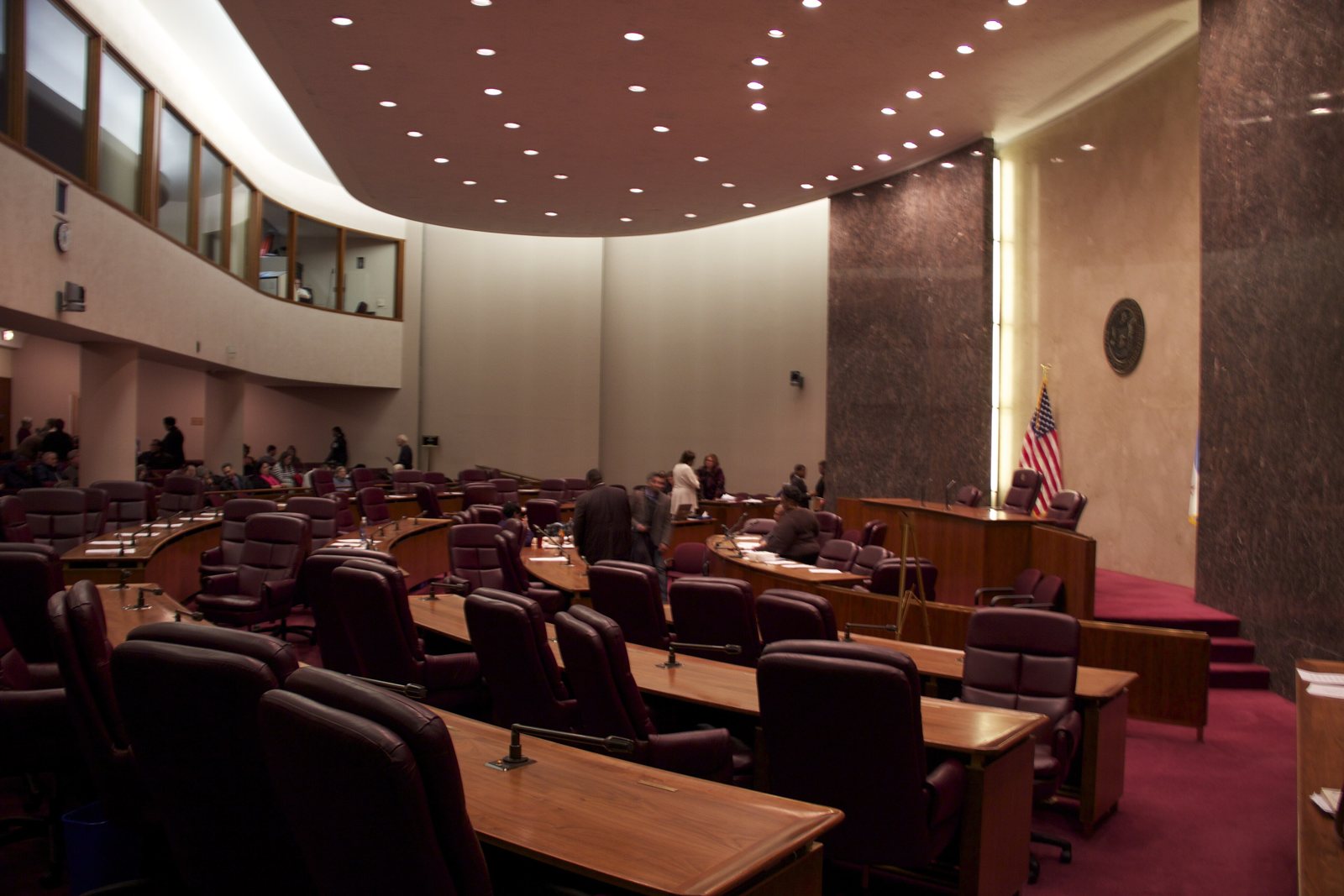


Twenty-eight of Chicago's 50 aldermen told Mayor Brandon Johnson on Nov. 10 that his proposed 2027 budget is "a non-starter" and does not have the 26 votes it needs, according to FOX 32. The letter, from a group calling itself the Budget Accountability Coalition, targets two tax proposals in a $17.6 billion spending plan that is meant to close an $882.4 million gap. The mayor has not withdrawn either one. Both sides say they want to talk, and neither has produced a plan the other has accepted.
The numbers in one place: a $17.6 billion budget, an $882.4 million gap, 26 votes needed, 28 aldermen opposed, $335 million from the two disputed taxes, and at least $8.1 billion in debt owed to the city.
What the aldermen object to
The letter names two proposals. The first is an employer head tax, branded the Equitable Employer Tax, of $25 per employee per month on businesses with more than 125 employees. The Sun-Times reports that covers about 2.8 percent of registered corporations and is projected to raise $101 million a year. Employers with work sites in census tracts the city designates as socio-economically disadvantaged can apply for a full rebate. The second is an increase in the personal property lease transaction tax from 15 percent to 20 percent, projected to raise $234 million in 2027. That tax applies to equipment rentals and to certain software and cloud services. Car leasing stays at 15 percent, and the Sun-Times reports the rate for film and television production would fall from 15 percent to 11 percent.
The coalition's letter says: "We will not vote for a budget that includes a tax on jobs," CBS Chicago reports. The coalition asks for a revised budget that closes the gap without new pressure on employers, small businesses and taxpayers.
What each tax would cost
At $25 a month, the head tax is $300 per covered employee per year. The table shows what that means for a company of a given size. These are our calculations from the reported rate, not figures from the city, and they ignore any rebate.
| Covered employer | Per month | Per year |
|---|---|---|
| 126 employees | $3,150 | $37,800 |
| 200 employees | $5,000 | $60,000 |
| 500 employees | $12,500 | $150,000 |
| 1,000 employees | $25,000 | $300,000 |
Last year's version was revised several times and ended at $33 per employee for companies with more than 500 workers, the Sun-Times reports. A coalition of moderate and conservative aldermen rejected it. Pat Dowell (3rd), the Finance Committee chair, called it a "non-starter" then and used the same word this year. She is one of the 28 signers.
| Lease tax rate | Rate | Change |
|---|---|---|
| Through 2025 | 11% | Reported by critics |
| Jan. 1, 2026 | 15% | +4 points, +36% in the rate |
| Proposed for 2027 | 20% | +5 points, +33% in the rate |
| 11% to 20% overall | +9 points, +82% in the rate |
Critics note the lease tax rose from 11 percent to 15 percent on Jan. 1, 2026. Some of them say it was supposed to stay frozen for two years. We could not confirm the legal basis for a freeze: a consultant report and a news report we reviewed point in different directions, so we are not treating it as established.
The gap, and how much the two taxes cover
| Item | Amount | Source |
|---|---|---|
| Projected 2027 gap | $882.4 million | City forecast |
| Head tax + lease tax estimates | $335 million | Sun-Times (101 + 234) |
| Share of the gap | About 38% | ReoFact arithmetic |
| Left to find if both pass | About $547 million | ReoFact arithmetic |
| Debt owed to the city | At least $8.1 billion | OIG audit, April 16, 2026 |
| Potentially collectible | About $3 billion | Coalition letter, per Fox 32 |
Together the two disputed taxes are projected at $335 million, about 38 percent of the $882.4 million gap by our arithmetic. If both were dropped and nothing replaced them, roughly $547 million would remain to find, unless other revenue or cuts fill it. The coalition says outstanding debt, spending cuts and the cost-saving recommendations from consultant Ernst & Young could do that. The letter gives no revenue estimates for its own proposals, according to FOX 32.
Other revenue in the mayor's plan
The disputed taxes are not the only new revenue. These are the proposals the Sun-Times lists, with the figures it reports.
| Proposal | Projected | Source |
|---|---|---|
| Employer head tax ("Equitable Employer Tax") | $101 million a year | Sun-Times |
| Personal property lease tax, 15% to 20% | $234 million in 2027 | Sun-Times |
| Sports betting tax, 10.25% to 20% | About $37 million a year | Sun-Times |
| Packaged liquor tax, 2.38% to 3% | $13.8 million | Sun-Times |
| Packaging tax, 15 cents per container | About $9 million a year | Sun-Times |
| Vehicle debt amnesty | $6 million | Sun-Times |
| Smart Streets expansion | $12.8 million | Sun-Times |
The sports betting increase is subject to a court challenge by the Sports Betting Alliance, the Sun-Times reports. These seven items add up to $413.6 million by our arithmetic. They are not the whole plan: the budget also counts a $520 million surplus from tax increment financing districts, with 55 percent, or $286 million, earmarked for Chicago Public Schools, down from a $1 billion surplus last year. It includes a $360 million pension payment above the $2.79 billion required, and $480 million in borrowing over two years for a $260.8 million police misconduct settlement and other settlements. The Sun-Times cites $364 million for the pension payment elsewhere in its story, so treat $360 million as approximate.
The debt the aldermen point to
The letter cites the city's Inspector General. The Office of Inspector General published an audit of the Department of Finance's debt management on April 16, 2026. It found the city is owed at least $8.1 billion, and that this is a floor because no city department has full oversight of the debt. Deborah Witzburg, then the Inspector General, said: "The City is in dire financial straits," according to Citizen Newspaper Group.
The audit says the debt comes from overdue charges for city services, unpaid fines for Municipal Code violations, emergency medical services, and interest and collection costs. Some of it dates to the 1990s. It also finds that debt collection disproportionately affects economically vulnerable residents, particularly where fines and fees are concentrated in higher-poverty areas. It recommends a formal debt management plan, standard definitions of debt across departments, supervision of collection agency contractors, and better tracking tools. The Department of Finance says it will explore writing off uncollectible debt.
The coalition's letter puts about $3 billion of that as potentially collectible, per FOX 32, and proposes stepping up collection with exemptions for people facing financial hardship, according to CBS Chicago. Two caveats apply. The $8.1 billion is a total built up over decades, while the $882.4 million gap is a single year, so collecting on the debt would take time and would not arrive on the budget's schedule. And the audit itself warns that collection falls hardest on lower-income residents, which sits uneasily with a plan that depends on collecting more.
The mayor's response
Johnson wrote to all 50 aldermen. His office is working on changes to the head tax's credits and to the lease tax proposal, with no specifics yet, according to CBS Chicago, which quotes him: "I remain open to all concepts and look forward to reviewing more options." Johnson has defended the taxes. "Working people are being forced out of cities across America. Corporations are not," he said when the budget was released, according to the Sun-Times. On the opposition, he said: "No one has come up with a viable solution other than saying what they do not want," FOX 32 reports. He added: "If we like the investments, we have to fund them." FOX 32 reports he has not withdrawn either tax.
Ald. William Hall (6th), who did not sign the letter, said, "Let's see an alternative budget," FOX 32 reports. Ald. Scott Waguespack (32nd), who signed, said: "Instead of having savings and efficiencies worth hundreds of millions of dollars, he's just doubled down."
The vote math
The Council has 50 members and a budget needs 26 votes. With 28 aldermen on the letter, the mayor could count on at most 22 yes votes if every signer holds. He would need to move at least 4 of them to reach 26. That is our arithmetic, and a signature on a letter is not a recorded vote. FOX 32 reports the deadline is the end of the year. A separate Nov. 2 Council vote, 44 to 6, directed $75 million from the city's parking meter deal to an extra pension payment this year, CBS Chicago and FOX 32 report. Ald. Bill Conway (34th) said the money "was clearly meant as a one-time little shot in the arm to these pensions."
The 28 aldermen on the letter
These are the signers as listed by FOX 32. The video shows the same 28 wards.
| Ward | Alderperson | Ward | Alderperson |
|---|---|---|---|
| 2 | Brian Hopkins | 24 | Monique Scott |
| 3 | Pat Dowell | 31 | Felix Cardona Jr. |
| 5 | Desmon Yancy | 32 | Scott Waguespack |
| 7 | Greg Mitchell | 34 | Bill Conway |
| 8 | Michelle Harris | 36 | Gilbert Villegas |
| 9 | Anthony Beale | 37 | Emma Mitts |
| 10 | Peter Chico | 38 | Nicholas Sposato |
| 11 | Nicole Lee | 39 | Samantha Nugent |
| 13 | Marty Quinn | 41 | Anthony Napolitano |
| 15 | Raymond Lopez | 42 | Brendan Reilly |
| 16 | Stephanie Coleman | 43 | Timmy Knudsen |
| 18 | Derrick Curtis | 44 | Bennett Lawson |
| 19 | Matt O'Shea | 45 | James Gardiner |
| 23 | Silvana Tabares | 50 | Debra Silverstein |
What we could not confirm
We have not seen the letter itself. The signer list comes from FOX 32, and the "tax on jobs" quote comes from CBS Chicago. We did not verify the $3 billion collectible estimate against a city document or confirm the time frame behind it. The audit coverage we reviewed gives no dollar breakdown of the $8.1 billion by category, so we do not report one. The lease tax freeze claim is unresolved, as described above. The head tax and lease tax revenue figures are the mayor's office's estimates as reported by the Sun-Times, and the coalition's letter gives none for its own proposals. We could not open the WTTW report on the end of budget hearings, so it is listed but not quoted. We did not read the full 675-page budget for this story.
Our question
The gap is $882.4 million. If the head tax and the lease increase are out, what should Chicago cut, collect or raise instead? Tell us on YouTube, Instagram or Facebook, or write to contact@reofact.com.
Photos: City Council chamber by Daniel X. O'Neil, CC BY 2.0. City Hall interior by Kenneth C. Zirkel, CC BY-SA 4.0. Mayor's portrait: City of Chicago. Alderperson portraits and the Inspector General portrait shown in the video come from official sites, City Club of Chicago and Wikimedia Commons, credited on screen or in the video description.